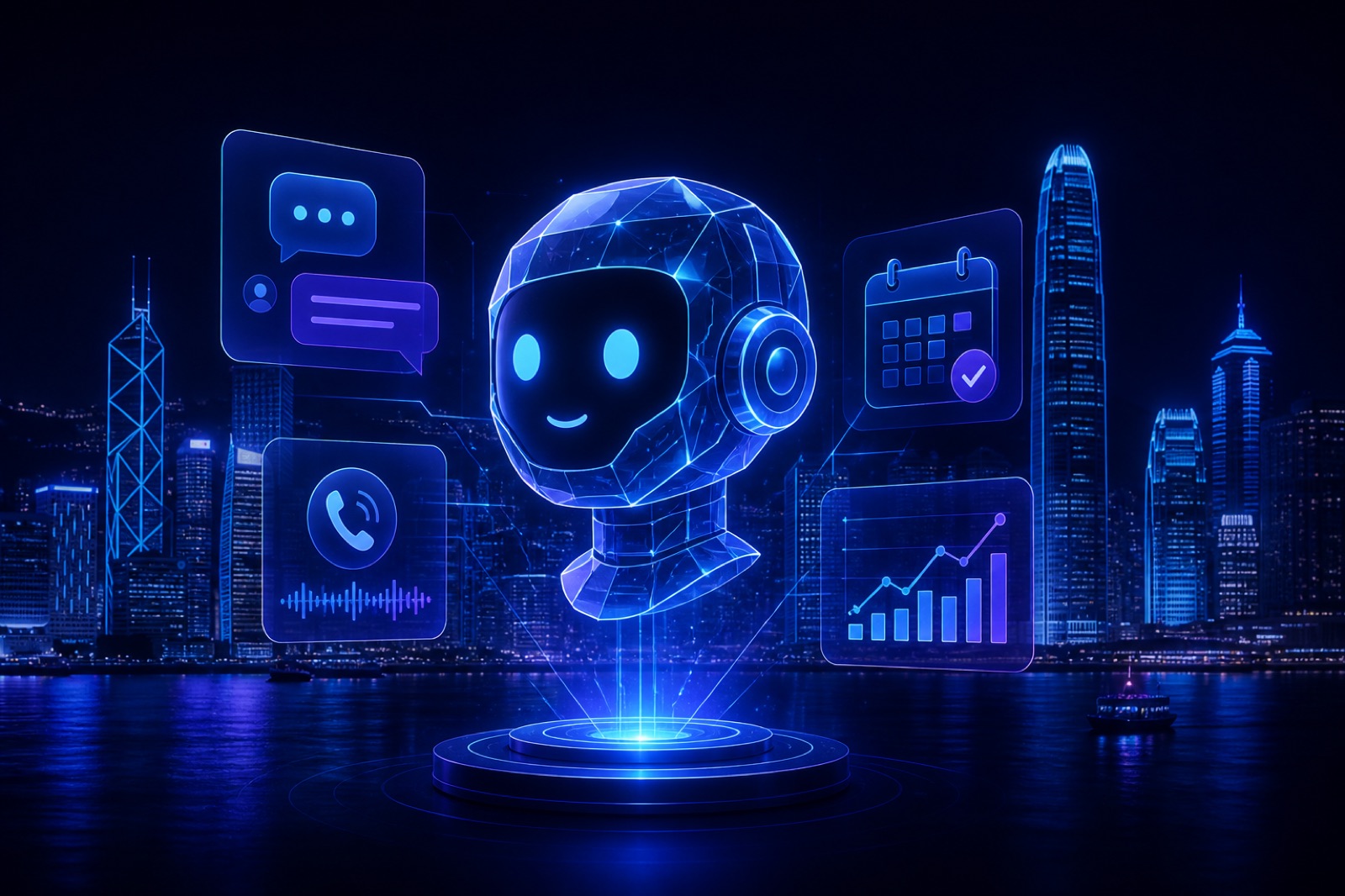
Somewhere in Hong Kong right now, a customer is messaging a business at 11:47 p.m. asking if they can book for tomorrow. At most companies, that message sits unread until morning — and by morning, the customer has booked with someone else. At a growing number of businesses, an AI agent replied within three seconds, answered the question, and confirmed the booking. This guide explains, in plain English, how that works and how to get it.
What exactly is an AI agent?
Think of an AI agent as a digital employee. Not a clunky chatbot from 2019 that says "Sorry, I didn't understand that" — a modern AI agent understands natural language, knows your business inside out, and can actually do things: answer questions, qualify leads, book appointments, send follow-ups, update your CRM, and escalate to a human when it genuinely needs to.
The difference between a chatbot and an agent comes down to one word: action. A chatbot talks. An agent talks and acts — it's connected to your calendar, your WhatsApp, your customer database, and your internal tools, so a conversation can end with something real getting done.
"A chatbot answers questions. An AI agent finishes the job — books the slot, updates the record, sends the confirmation — before a human even wakes up."
Why 2026 is the year this matters for Hong Kong
Hong Kong's labour market makes the maths brutally simple. A full-time customer service employee costs upwards of HK$20,000–25,000 per month, works around 44 hours a week, and — through no fault of their own — cannot be awake at 3 a.m. when your overseas customer emails. Meanwhile, customer expectations have shifted: people who get instant replies from large companies now expect them from everyone.
At the same time, the technology finally caught up. The large language models behind today's agents handle Cantonese, Mandarin, and English fluently in the same conversation — which matters enormously in a market where a single customer thread can switch between all three.
The five highest-ROI use cases we deploy
1. WhatsApp reception
Hong Kong runs on WhatsApp. An agent connected to your business number answers product questions, checks availability, and books appointments directly into your calendar — instantly, at any hour. This is consistently the fastest payback deployment we do.
2. AI voice receptionist
Every missed call is a missed customer. A voice agent picks up in two rings, handles bookings and common questions in the caller's language, and texts you a summary. Clinics, salons, restaurants, and property agencies see the biggest impact.
3. Lead qualification
Instead of your sales team chasing every enquiry, the agent asks the qualifying questions first — budget, timeline, requirements — and hands over only the serious prospects, with full context attached. Your team spends time closing, not filtering.
4. Customer support deflection
Sixty to eighty percent of support questions are repetitive: "Where's my order?", "What are your hours?", "How do I reset this?" An agent trained on your documentation answers those instantly and routes the genuinely hard cases to a human — with the history already summarised.
5. Internal operations
The invisible one: agents that generate quotes, chase unpaid invoices, compile weekly reports, and move data between systems that don't talk to each other. Less glamorous, often the biggest time saving of all.
What it actually costs
The honest answer: far less than a hire. A single-purpose agent — say, a WhatsApp booking assistant — starts around HK$2,999/month fully managed, including setup. A multi-agent setup covering reception, lead qualification, and support typically runs HK$6,999/month. Compare that with one junior employee at HK$20,000+ per month who covers one shift, five days a week.
Rule of thumb: if your team answers the same five questions more than twenty times a week, or you miss more than five calls a week, an AI agent pays for itself in the first month.
How deployment works (it's one week, not one quarter)
The biggest misconception we hear is that AI adoption is a six-month IT project. A production agent goes live in days:
- Day 1–2 — Discovery. We map your workflows, collect your FAQs, pricing, and policies, and define exactly what the agent should and shouldn't do.
- Day 3–4 — Build & training. The agent is trained on your business knowledge and connected to your channels — WhatsApp, phone, website — and tools like your calendar or CRM.
- Day 5 — Testing. You throw real scenarios at it, we tighten the responses, and set the escalation rules for when a human takes over.
- Day 6–7 — Go live. The agent starts handling real conversations, with our team monitoring every exchange in the first weeks and improving it continuously.
From there it's a managed service: we watch performance, retrain the agent as your business changes, and send you a monthly report showing conversations handled, bookings made, and hours saved.
Where to start
Don't start with technology — start with one bottleneck. The question we ask every business owner is: "What's the one repetitive conversation that eats the most of your team's time?" That's your first agent. Deploy it, measure it for a month, then expand. Businesses that start small and scale on evidence get dramatically better results than ones that try to automate everything on day one.
If you want a second opinion on where AI would pay off fastest in your business, that's literally what our free strategy call is for — thirty minutes, no obligation, and you leave with a concrete roadmap either way.

Ready to see what an AI agent could do for you?
Book a free 30-minute strategy session — we'll map your highest-ROI automation and give you a clear roadmap, no strings attached.